Written by
Josya Hemrajani
Published on
August 12, 2026

%20copy.png)

Retail media is dominating marketing headlines, often called digital advertising's third wave after search and social. As traditional ad channels slow down, Retail Media Networks (RMNs) are growing fast. Industry reports project global retail media spend will reach $230 billion by 2028 (BCG), while UK spend alone is expected to hit $8 billion by 2027 (eMarketer).
Yet despite all this money moving around, enterprise retail media marketing has a major blind spot. While brands pour billions into online retail ads to track exact sales, over 80% of actual shopping still happens inside physical stores. Most retail media networks focus almost entirely on national websites and generic online banner ads. In doing so, they completely miss the neighbourhood store where local retail media decisions actually happen.
To understand why this blind spot exists, we need to look at how retail advertising evolved, why old-school store displays fall short, and how off-site retail media is replacing outdated paper mail with trackable, local social media ads.
Retail media is simple: supplier brands (like Coca-Cola or Heinz) pay retailers (like Tesco or SPAR) to promote products directly to shoppers using the store's own touchpoints and customer data.
The evolution of retail media in grocery is really the story of how retailers have moved from selling shelf space to selling audience access. While the technology has changed dramatically, the commercial model has remained remarkably similar: brands pay retailers to influence shoppers at the point where purchase decisions are made.
Here's how that evolution unfolded.
For decades, grocery retailers monetised their stores primarily through physical visibility. Brands invested heavily in physical in-store promotions, including end-of-aisle displays, shelf-edge labels, floor stickers, hanging signage, printed leaflets, product sampling, checkout displays and window posters, all designed to capture shoppers' attention at the point of purchase.
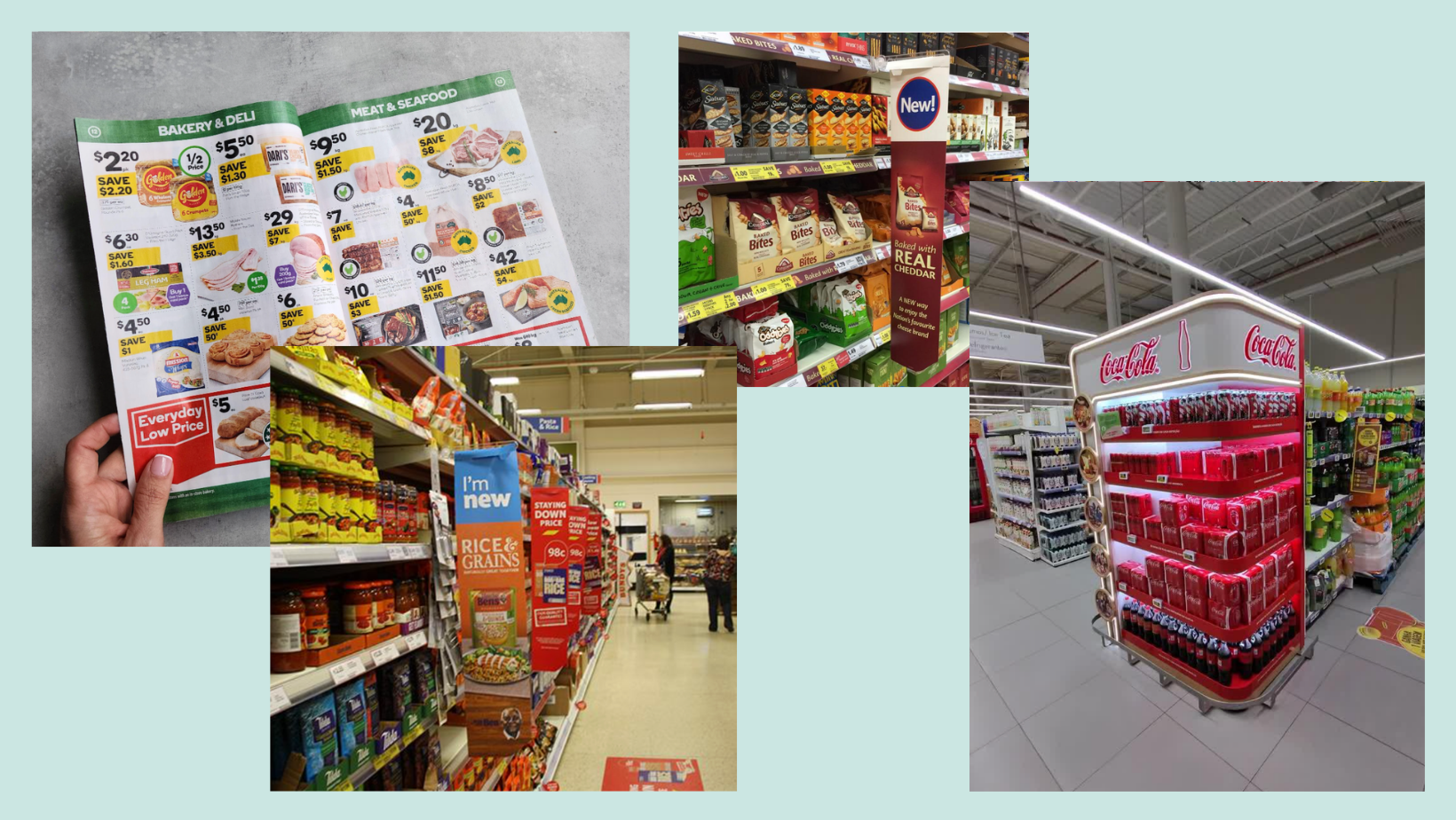
These weren't called "retail media" at the time. They were generally known as:
The objective was simple: Influence shoppers during the final few minutes before purchase. At that time, over 70% of grocery purchase decisions are made or influenced in-store; this meant manufacturers were willing to pay retailers for premium visibility.
Retailer revenue from these activities typically came through promotional funding, listing fees, display fees, cooperative advertising budgets and category management agreements, with suppliers paying for increased visibility and influence within the store environment.
Although effective at driving shopper attention, this traditional model had significant limitations. Campaigns lacked targeting capabilities, meaning every shopper received the same message regardless of relevance, while measuring return on investment was challenging. In addition, the production, printing and manual installation of materials created significant operational costs, and campaigns often required weeks of planning and coordination before going live.
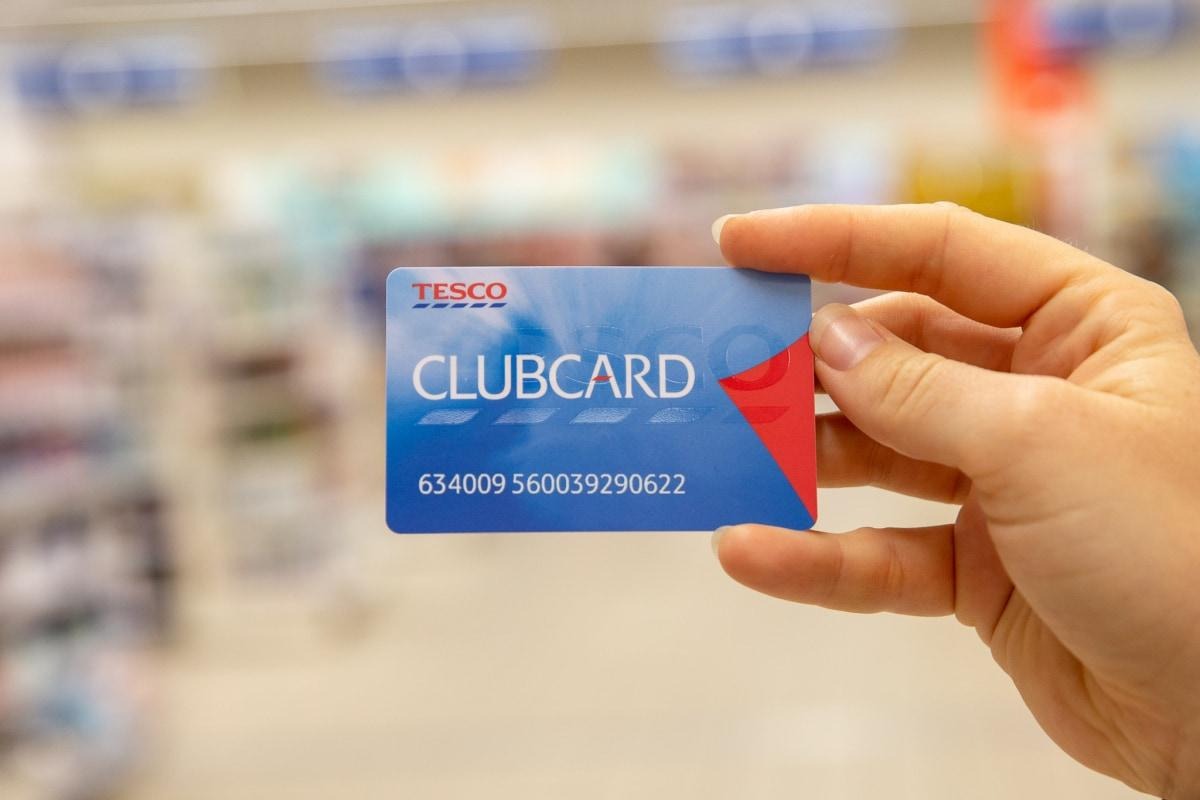
The next major shift came with loyalty programmes.
Retailers such as:
began collecting first-party customer data.
For the first time retailers knew who was buying, what they bought, when they bought & how often they shopped. This transformed retailer value. Instead of simply owning shelves, retailers now owned rich customer insight that brands couldn't get anywhere else.
However, advertising was still largely physical.
As shoppers increasingly interacted with retailers online, new advertising inventory became available.
Retailers launched:
Brands could now purchase placements on homepage banners, search results, category pages, product pages, retailer emails & mobile push notifications. This marked the beginning of modern digital retail media.
Instead of buying an end cap, a supplier could buy the top sponsored result when a shopper searched for "coffee." The biggest advantage of digital retail media was its measurability. For the first time, brands could track impressions, clicks, conversions and sales attribution, precisely target specific audiences, and launch campaigns in a matter of hours rather than weeks.
As digital capabilities matured, retailers recognised that advertising was no longer simply a merchandising activity - it was a strategic revenue stream.
This led to the emergence of dedicated Retail Media Networks (RMNs), transforming retailers into media owners in their own right. Industry leaders such as Amazon, Walmart, Tesco, Carrefour and Albertsons have built sophisticated advertising platforms that enable brands to engage shoppers across sponsored search, display advertising, video, digital in-store screens, personalised email and off-site campaigns powered by retailer first-party data.
Here are all the different types of Retail Media:
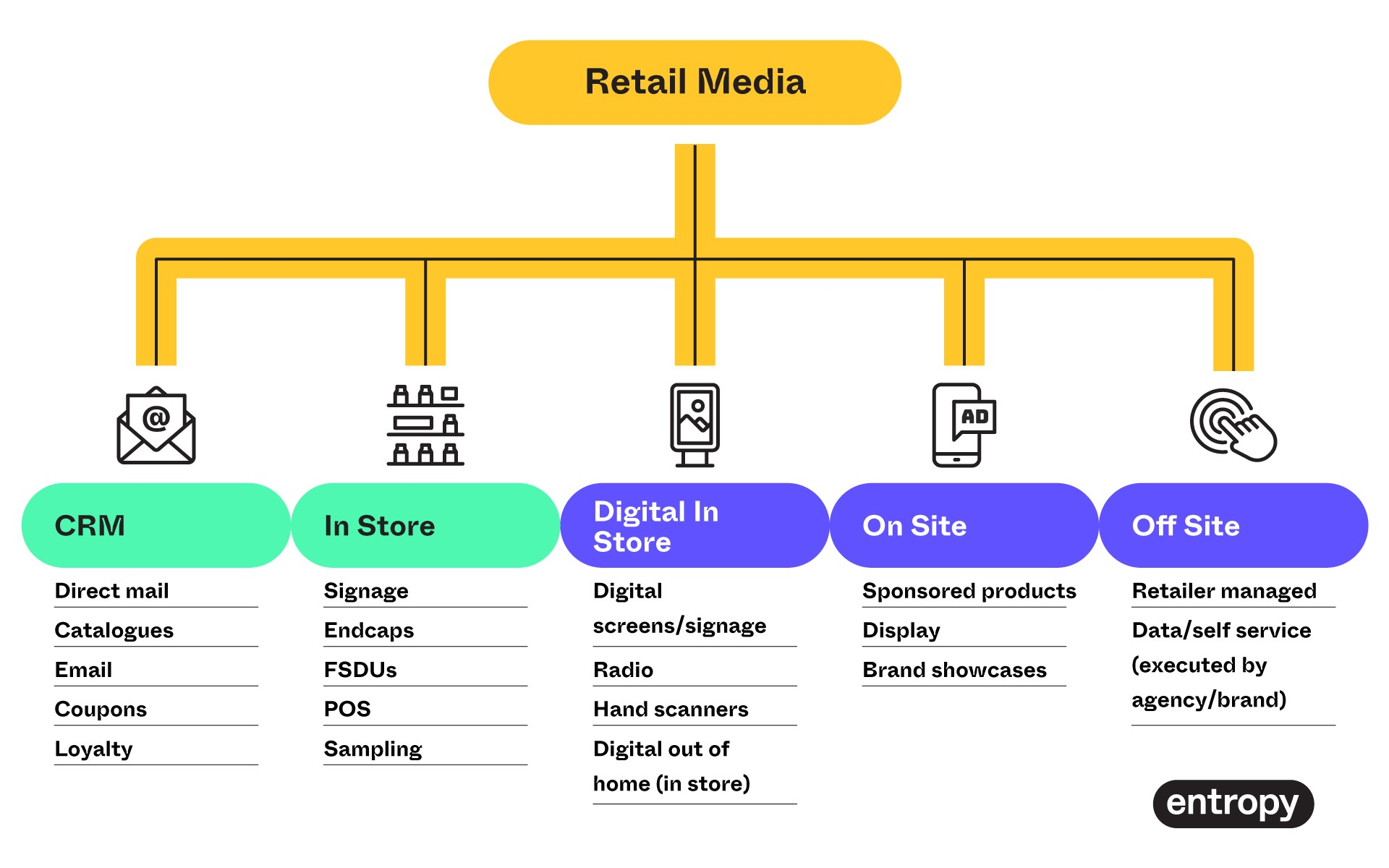
Crucially, these networks offer closed-loop measurement, allowing brands to understand not only who saw an advert, but whether it influenced an actual purchase. This level of accountability has fundamentally changed how advertising performance is measured, positioning retail media as one of the fastest-growing and most valuable channels in modern marketing.
Today's grocery retail media combines physical and digital experiences. Instead of choosing one channel, brands can reach shoppers across multiple touchpoints throughout the buying journey.
.png)
Today, retail media spans a wide range of digital and physical touchpoints, including on-site advertising across retailer websites and apps, in-store digital media, off-site advertising powered by retailer audiences, email and CRM channels, loyalty programmes, digital coupons, local social media and, in some markets, connected TV.
This is where companies like SocioLocal fit into the evolution.
Historically, retail media has focused on retailer-owned channels such as websites, apps, email and in-store displays. However, individual store social media pages have often been overlooked despite having established, highly engaged local audiences.
Local digital retail media extends the same principle beyond the retailer's owned ecommerce channels. Instead of a supplier paying only for visibility on a retailer's website or in-store screens, they can also promote products through trusted local store social pages where shoppers already engage with their neighbourhood store.
This approach offers several advantages over traditional POS:
In many ways, local social media is the digital successor to traditional printed POS: it still leverages the retailer's trusted relationship with shoppers, but with greater speed, targeting, scalability and measurable performance.
When a retail chain sets up individual social media pages for each store, local shoppers pay attention. For example, our client accounts have consistently shown that local store accounts get huge community interest, often far more engagement than the main corporate brand page. Across 30 SPAR and EUROSPAR store locations over a five-week trial, SocioLocal delivered astonishing results: saving store teams an estimated 320 total hours of manual labour while generating over 500,000 additional local social impressions. Read the full case study here.
From Physical Store Assets to Digital Audience Assets
The history of grocery retail media can be summarised in one sentence:
Retail media has evolved from paying for physical shelf visibility to paying for targeted, measurable access to retailer-owned audiences.
The retailer's role has changed from simply providing physical space in-store to providing access to first-party customer relationships across every stage of the shopping journey. That shift, from selling space to selling audiences, is what defines modern retail media.

