Written by
Robert Brusasca
Published on
April 8, 2026

.png)
Despite years of growth in digital marketing, social media still faces scrutiny at the executive level, particularly from Chief Financial Officers. The reason is simple: most social strategies are not framed in financial terms. Marketing teams often report on impressions, engagement rates or follower growth. While useful operationally, these metrics rarely translate into the language CFOs prioritise: revenue impact, cost efficiency and return on investment.
The data supports this disconnect. Research consistently shows that only 30% of marketers effectively measure social media ROI (Return on Investment), and 93% say measuring ROI is their biggest challenge. When the majority of the marketing team struggles to clearly quantify the financial impact of social media, it is understandable that finance leaders remain cautious about investment.
From a finance perspective, social media can appear inconsistent, difficult to attribute and overly dependent on trends. Without a clear link to measurable business outcomes, it is often categorised as a cost centre rather than a growth driver.
This is where organisations fall short. The issue is not that social media lacks value; it’s that its value is rarely articulated in a way that aligns with financial decision-making. For multi-location brands (MLBs), this gap is even more significant. While they operate at scale, they often fail to demonstrate how social activity across individual locations contributes to aggregate revenue growth.
To secure CFO buy-in, social media must be repositioned; not as a branding tool, but as a distributed revenue channel. This is particularly true for MLBs, where each store can influence local demand. Platforms like TikTok and Instagram now function as local discovery engines, shaping where consumers choose to shop, eat or engage.
According to ZipDo, 59% of small businesses report revenue growth linked to TikTok, while younger audiences increasingly rely on social platforms to discover nearby businesses. For MLBs, this behaviour scales across every location. The strategic shift is clear: Social Media is no longer just about visibility; it is about capturing intent at the point of local discovery.
When executed correctly, local social activity can:
In financial terms, this means lower CAC (Customer Acquisition Cost) and improved LTV (Lifetime Value) through stronger local engagement. This is particularly important when considering how consumers now interact with brands online. 78% of consumers discover new brands through social media, while 54% use social platforms to research products before making a purchase. In other words, social media is no longer simply a communication channel; it is a primary discovery and decision-making layer within the customer journey.
When social activity is decentralised and consistent, brands effectively create hundreds of local touchpoints operating simultaneously.
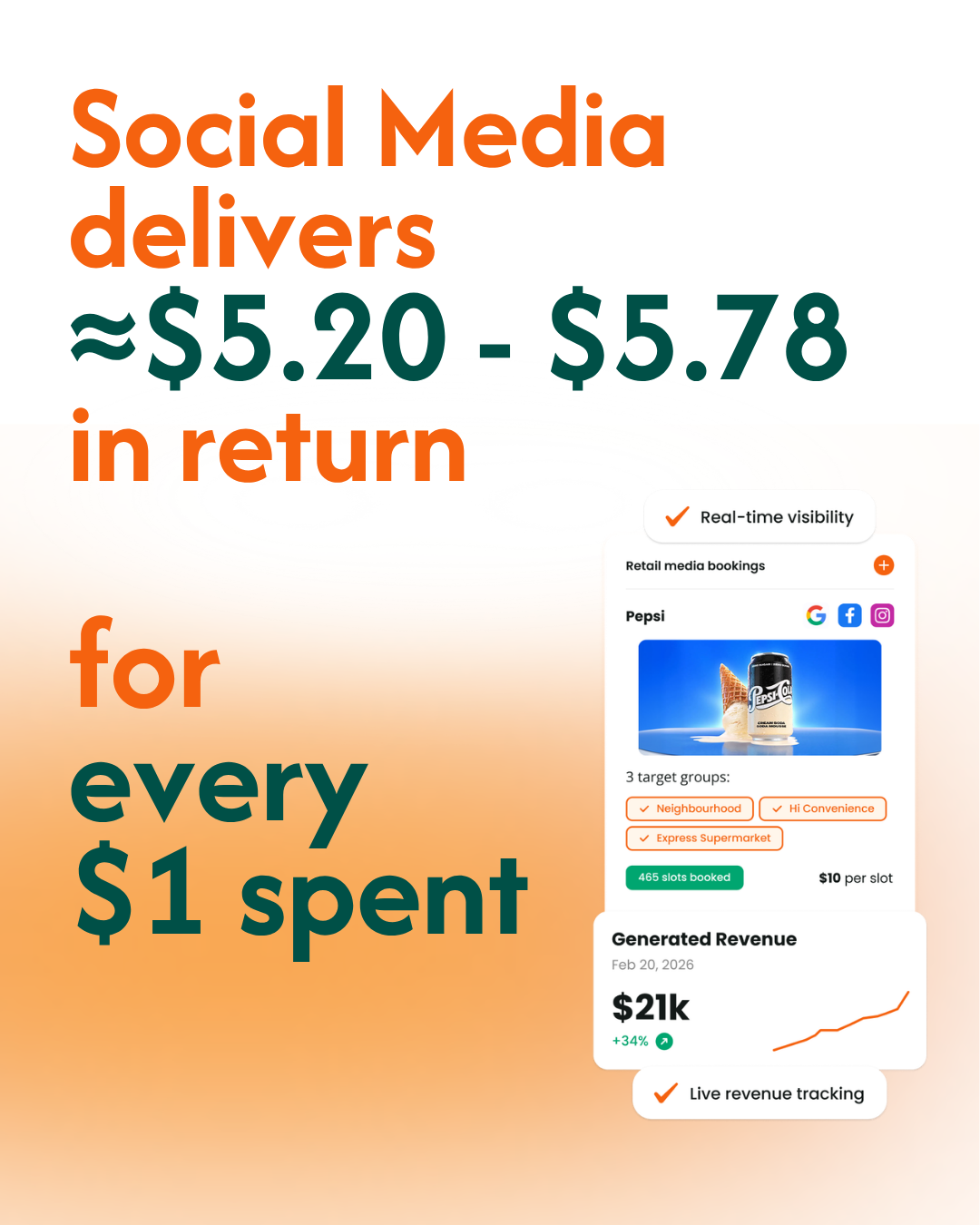
To move social media into the investment category, marketing leaders must anchor performance in metrics that align with financial outcomes. When evaluated through the right lens, the data tells a very different story: social media delivers approximately $5.20 - $5.78 in return for every $1 spent, and 84% of brands report positive ROI from their social campaigns.
For single-location businesses, social media impact is inherently limited by scale. For MLBs, the opposite is true. Each location represents a unique audience, a distinct community, and an independent opportunity for discovery.
An Eddie Rocket’s case study conducted by SocioLocal provides a clear example of how local social directly drives revenue outcomes. Over a 5-week campaign across 22 stores:
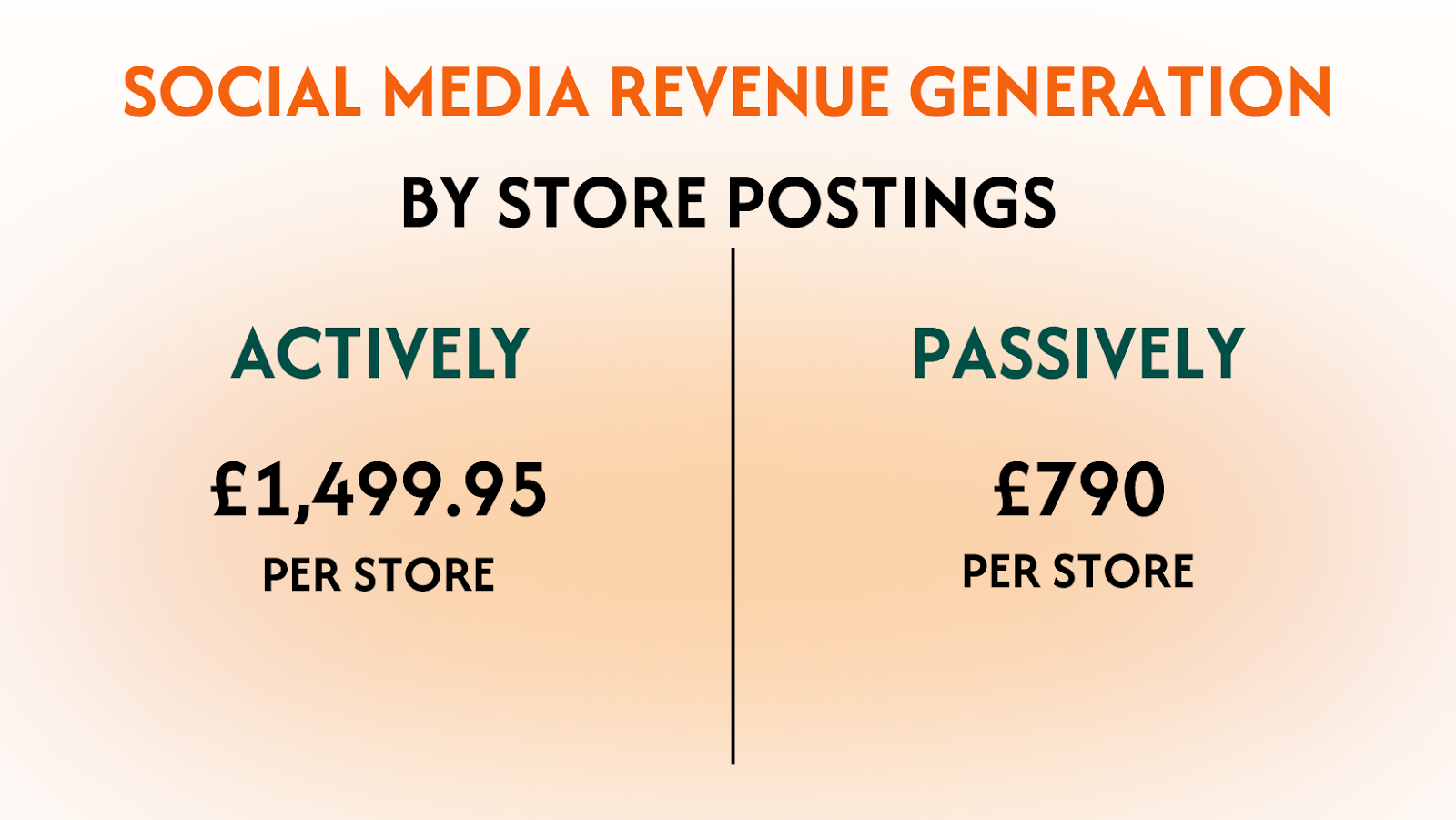
These results represent around 90% higher sales performance in stores using social media. Therefore, the correlation between social reach and sales velocity is clear, and CFO’s should begin to reframe social media from “a branding activity with unclear ROI” to “a measurable driver of store-level revenue uplift”.
Consider the commercial implication: If one store generates incremental revenue through local social activity, the impact is modest. If 100 stores achieve the same result, the outcome becomes transformational.
This is what makes local social one of the most underpriced growth channels available to multi-location brands today. The marginal cost of producing additional content is low, but the cumulative revenue potential is substantial. However, this advantage only materialises when social activity is structured and scalable.
Despite the opportunity, many Multi-Location Brands or Franchises struggle to demonstrate tangible returns from social media. The primary reason is not strategy; it is execution. Common challenges include:
Without consistency, it becomes impossible to measure impact. Without measurement, it becomes impossible to justify investment. As a result, social remains fragmented, managed at the store level without central oversight, or controlled centrally without local relevance. In both cases, the ability to scale ROI is lost.
For CFOs, this lack of structure reinforces the perception that social media is unpredictable and difficult to govern.
To unlock the full commercial potential of social media, MLBs must move from ad hoc execution to operationalised systems. This requires three core elements:
This is where SocioLocal plays a critical role. By combining central control with local flexibility, brands can ensure that every location contributes to a unified growth strategy while retaining the authenticity that drives engagement.
Instead of managing social as a fragmented activity, it becomes a coordinated revenue engine.
Social media is no longer an experimental channel; it is a critical layer of how consumers discover and engage with brands at a local level. For multi-location brands, the opportunity is clear: turn every store into a consistent, visible and revenue-generating presence within its community.
When social media is aligned across leadership teams and measured against financial outcomes, the commercial impact becomes clear: strong ROI benchmarks often exceeding 5x returns, lower customer acquisition costs, and a direct influence on purchase behaviour throughout the customer journey.
The brands that succeed will treat social as operational infrastructure rather than standalone content. That means embedding it into their operating model, enabling local teams to execute effectively, and measuring performance in terms that matter to the business.
SocioLocal enables this shift by providing the structure, visibility and control required to turn local social media into a predictable, scalable growth engine.
📲 Want to position social media as a revenue channel within your organisation? Book a demo with SocioLocal to see how multi-location brands are scaling local growth through structured social execution.


